HELLO!
I want you to see the materials we used:
1. Shakers
2. Thumbs up and down
3. Cards
4. Disposable plates
5. Puzzle
6. handmade food and drinks items
7. Cards for the shopping list, bags and the list of shopping.




The warm up was used for reviewing the last topics they learned. We thought to focus on the numbers from one to twenty, days of the week and the actions verbs from the previous class.
They were called by the name and they picked up one card from the secret box. They had to tell me the number of the card and then they opened it and say whatever they found in the card.
Because this class is only once a week, I thought that they were going to be able to say what the card had inside, but they had troubles. They are still learning them and that is good so that everyone saw that they need more reinforcement in those topics. It is good to think that every class should review at least one part of the target language.

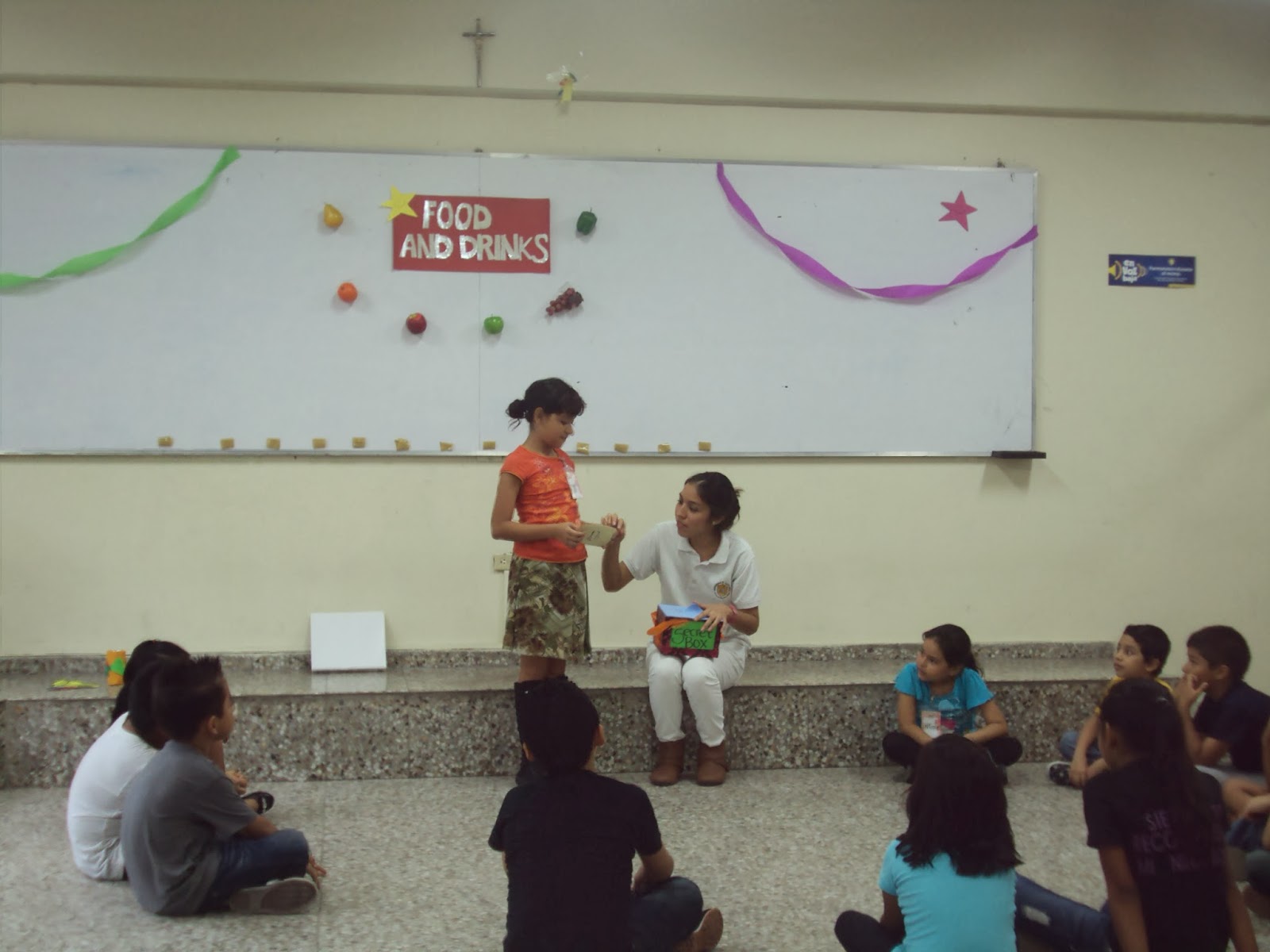
I called Maritza to be the first one. And when she passed in front and delivered the answer, the rest was able to copy what she did and when they were called they were familiar with the activity.
As I said before, they are still having problems with days of the week, numbers. Especially with the pronunciation of them. The actions were a little bit easy to produce.
One of the biggest challenges I had to overcome was to loose my fear of not delivereing the class as I had planned. As you see in the picture, I am using a puppet!
Using it was difficult, but I enjoyed the moment. They were expectant as you see in the picture. I had prepared a short conversation of the puppet "Toti" and me. The rest of the dialog was improvised and I think ir worked out. :)
Teacher Yanni told me to reherse my voice with the puppet and think about how can I manage the presentation of the topic with the puppet. Well, let me tell you that it was not easy to minimize my voice jejeje, I try to focused my own voice with the puppet's voice and there were moments where I felt that I mixed them. From that moment on, I felt very confident and happy because I felt that the children were very excited about the target language and they were remembering those words.


I used thirteen words. These were presented with the puppet. The puppet helped me to present them and I just hold the card for the students and they repeat after me or the puppet.
They were paying attention and like to see how much words they were learning. The funny moment arrived when I showed them the "soda" image. some say that students said "coki" jejejej, and everyone laught! Children are so creative at making up words!


I also asked them: Is water good or bad for you? they answered using their thumbs up or down. I was glad that they used them, because the next practices were also using these two tools.
 |
| They were very excited about participating! |

As they grabbed and pulled the food item out, I asked them the questions and finally we covered all the food.
Mercy was the teacher in the practice stage. What I considered Mercy achieved in her part, is that these children understood what food were good and bad.
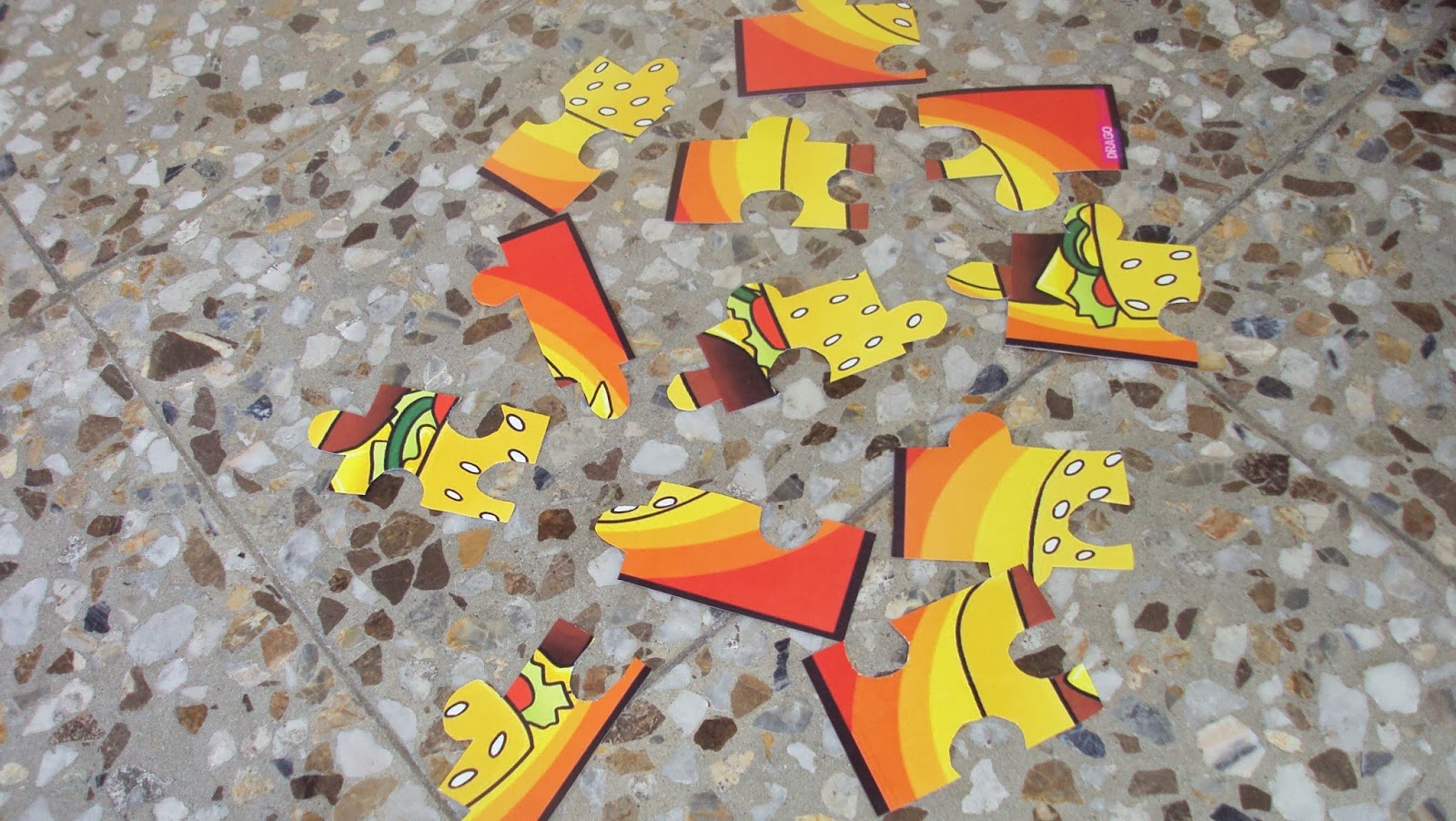
Another thing that I wanted to highlight is that since the previous activity had the children energetic, the next one was to put that energy in a hands-on activity. I mean, they had to put that energy into the puzzle and they did calm down.
The puzzle pieces were designed so that they can be challenged. If the puzzle was easy to put back, they were like "this is too easy for us". They were in pairs. Another thing that Mercy did was to put the youngest children with someone older.


It is not easy to prepare them not to be selfish, but in the case of most of the this group, I saw that the pair was working toguether. I did not anticipate that they were going to share, but I was glad.
Then, the next thing that I noticed is that the oldest children resolved very quickly the puzzle and they started to talk or move.
I think Mercy was immersed in other pairs and it was a moment where she was not really paying attention to them. However, they were not doing a big mess or interrumpting the class so much. What I did is to approached them is told them to be quiet. The pair of children that finished the task, called teacher Mercy and presented the puzzle. She asked them some questions and that was it.


sides.

As you see, they were very concentrated and liked to paste the items. Much importantly, they got the meaning of bad food and good food.
Something that Mercy did was to model how the activity was supposed to be done.
This was very important to do because if not children were to paste whatever they like in the incorrect sides of the disposable plate. When they finished, they recognize the two questions: Is pizza good for you? They said: "No, bad for you!!".
They work very hard and showed it to teacher Mercy. At the end, they all answered the questions that Mercy asked them.
What she should have questioned also was for the whole group the same questions with different items in the disposable plate, so that everyone say it out loud.

 Mercy regroup the children for the next activity. As you see, boys do not like to be with girls! When this happens, as teachers we have to tell them that we want them to colaborate. It is important not to negotiate with them, because if not next time they will do the same with us. Mercy managed it great. She decided the four groups and they were saying no, no, no with girls no! but Mercy forced them :D
The four groups were given four different list in which, they first had to fill in. The items that were in the list contained two or three missing words.
 Each group were filling in with some help of teacher Mercy. They spent more than five minutes because it was that easy, we wanted them to be challeged!!!
After completing the shopping list, they were standing in lines. As Mercy explained how to do the next step, they were ready to look for the items in the next side of the room.
As you might imagine they run, quiet fast to shop! Shoppaholic!


It took a while to complete the four items in each group, but they did it nicely!
the task was not done yet. Teacher Mercy had to check at least one bag, so she took one to see what they had collected.

They were so interested in this part of the lesson that they approached instantly next to teacher Mercy! They wanted to know how the groups did. Teacher Mercy picked one list and one bag from one of the teams. She was taking out the cards, asking questions and checking the list.

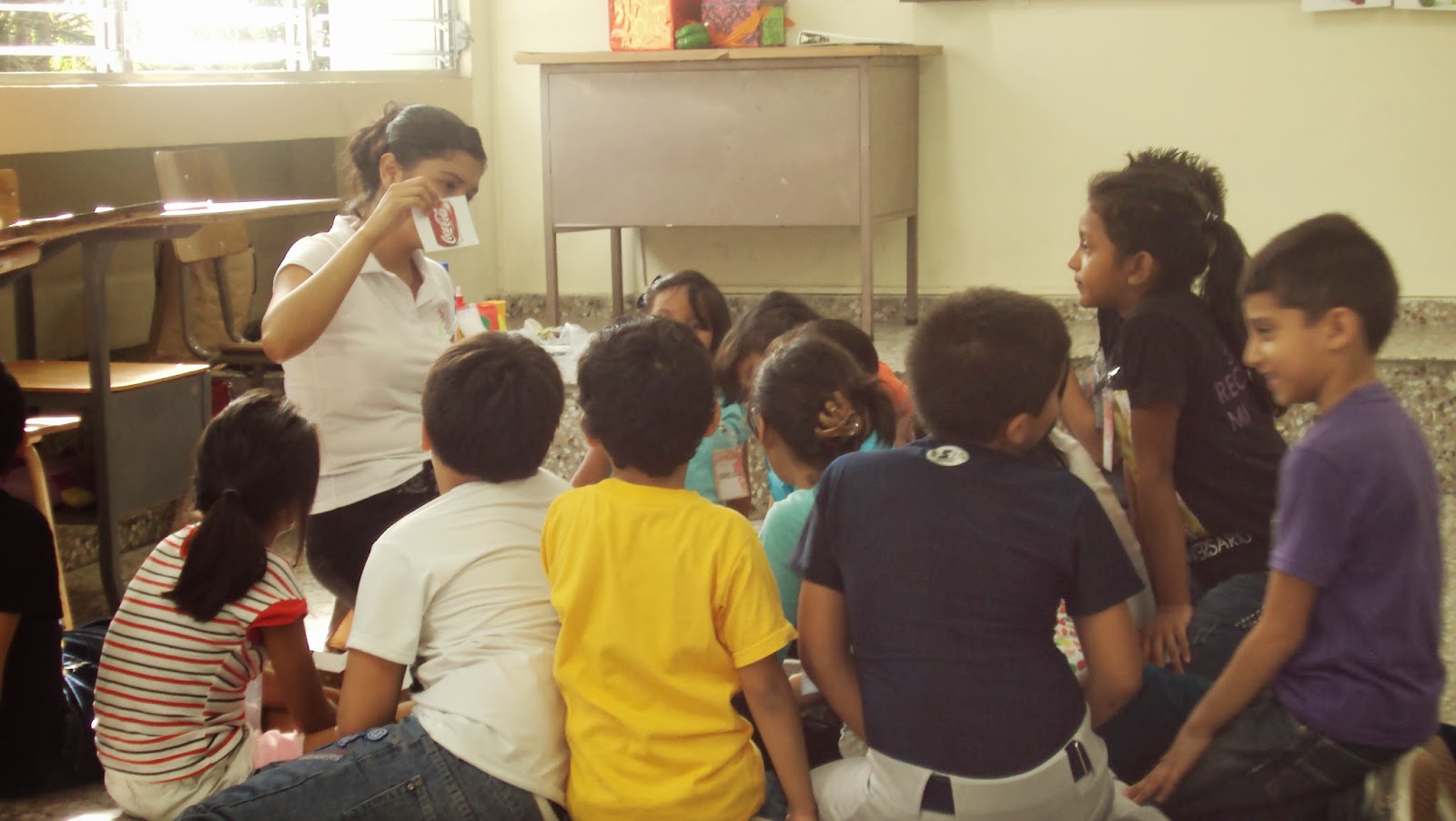
I really liked how she manage this last stage. She wanted to measure if they knew the vocabulay and how much they had learned up to that point.
What I learned from this last class is to fall every negative barrier from my mind. They were the ones that fight over me all the time. I overachieved most of those thoughts. I liked to present the topic this time, I felt confident and cannot wait to practice more the facts and ideas that were taught in this subject.
This is our planning:
|
Objective of the
lesson: By the end of this lesson, SWBAT
recognize and differentiate the bad food from the good one. In addition, they will be able to answer to
these questions in the last practice: “Is (water) good for you/Is (candy) bad
for you?” and say the correct answer “Yes, it is” and “No, it is not”.
|
|||
|
Time
|
Stage
|
Procedure
|
Notes
|
|
5
15
|
Welcome
Song
Warm up
|
I will set up the
song so the students can once again sing along with both teachers
Children stand up in a semi-circle and I will give them the directions
to follow.
The students will
be sitting down on the floor (semicircle). Teacher will have a secret box in
which a card will be taken out. The box will contain for example: a t-shirt
with the word “t-shirt” at the bottom of the card. A student will be called
out to pass and to grab one card out of the box. Teacher will ask: Color of the item; quantity; spelling. The vocabulary
included here will be: Days of the
week (Monday, Tuesday, Wednesday, Thursday, Friday, Saturday, and Sunday)
actions (swim, eat, and run, fly, climb and jump). Each of these images
will have also a number from 11-20 for review.
|
Aim of the activity: To get the students
sing. Also, in warm up, students will have the opportunity to review the
previous vocabulary, days of the week, numbers from 11-20, actions.
Type of learner: A-K-V
Interaction:teacher-students
Materials: cards with the old
vocabulary already learned.
Responsible: Ingrid Girón
|
|
15
|
Presentation
|
Introduce the topic
“Drinks and Food”using one puppet and a theater scenario to present the topic
to the children. They will be sitting down on the floor.
The puppet will
show each vocabulary item using the items of the fruits, vegetables and the
like made of carton. The puppet will
use these items to present them the vocabulary. After that, puppet will make
the students to repeat after me the name of the vocabulary items. Finally,
the puppet will ask them to repeat the word at least three times along with
him.
It will
also introduce the “good” and “bad” so that students know that not all food
is good for them. It will mark the difference.
Teacher will stress
the: Color and name of each vocabulary.
|
Aim of the
activity: Encounter and remember target
vocabulary.
Type of learner: V-A -
Interaction: Teacher (puppet)- students
Materials: puppet, cards with the
pictures of the food and drinks.
Responsible: Ingrid Giron
|
|
15’’
|
Practice
|
Activity 1: First,
students will sit down in front of the wall where they will have two big
circles. These two circles are going to be empty. The two circles will have a
sad and happy face inside.
There will be 2
groups of 8 children. I will choose or order these two groups and they will
have two boxes with them, each one for the two groups. What they will do is
to make two lines. The kids that are in front of the line are first. They
will introduce one hand and choose one item of a food or drink. They will
show it to the rest of the group and teacher will ask: What
is this?
And then when they
have answered: Is soda good for you?
Whether the item is healthy or unhealthy food or drink, that student
will make use of the correct answer (Yes, it is; No, it is not).
In order to avoid distractions or
boredom from the rest that are waiting for a turn, I will use the two
questions for them to respond as a group.
|
Aim of the activity: Students will learn to decide what type of food they have taken from
the box. Moreover, they will answer whether the food is good or bad for them.
Type of learner:V-A
Interaction: Teacher- Students
Materials: handmade items of food and drinks, two circles
on the wall, colorful box with the items of food in.
Responsible: Ingrid Giron
|
|
15’’
10-12’’
|
Activity
2: Ss sit
in a circle will work in pairs. I will give each pair the pieces of a puzzle.
Each pair will have a different puzzle (either a food or a drink item). When
they finish, I will ask which is the item and if it is food or bad (one
question to every member of the pairs).
Activity 3: Ss will be seated
in a circle. I will give each student a disposable plate divided in sections;
I will also give them food and drink items, so each of them can select the good
ones for pasting at the front of the plate, and the bad ones at the back.
Once they finish pasting the items, I will go to each of them for checking
the items by raising one of the plates in each student. For example, I raise
Imelda’s plate, and I point to the items in it (one by one) and ask them
“what is it?” (if it is better I can choose the S) and they say the items. I
also ask them if those items are in the right side. It will be with just one
of the two sides.
|
Aim of the activity: To use Ss’
cognitive skills and practice target language
Type of learner: V, A, T
Materials: pieces of puzzle, board, pictures with
all food items in the puzzles, glue, colorful pages.
Responsable: Mercy Márquez
Aim of the activity: differentiate good
and bad remembering target language.
Type of learner: V,A, T
Materials: disposable plates, glue, food and drink
items
Responsable: Mercy Márquez
|
|
|
15’’
|
Activity 4: Students will sit in a circle. I will give
them a shopping list to every S. Every word in the list will have missing
letters, so that Ss can complete the words before shopping. Once they have
completed the words (I will be checking all Ss’ list while they work for
making sure the words are well written), then I will make four groups of Ss.
In front of them, there will be drinks and food items. There will be a leader
in every group in order to check the list items, and the other three students
will run to look for the items in the list for completing the shopping list
(one item per student). Once they complete the list, they will show the list
and the items to me. I will get out the items of every group (one group at a
time), and all students will check with me if the list is completed. E.g.: if
there is water in the list, I will get out any item and ask “Is this water?”
and they will answer “Yes, it is” or “No, it is not” according to what they
see. When they say “Yes, it is”, I will also ask them “Is water good/bad for
you?” by showing them hands with thumbs up (good) or down (bad) so they have
a clearer understanding of what they are being asked.
Closure: We’ll
set up the song so the students can once again sing along with both teachers.
|
Aim of the activity:To
recognize food and drinks and internalize target language.
Type of learner:
Visual, auditory, kinesthetic, tactile
Materials:
shopping list, food and drink items, thumbs up/down, two baskets for carrying
the items,
Responsable: Mercy Márquez
|
|
My case of study
I liked how Imelda wanted to participate, even when the rest of the classmates think that she is too young or a baby, she is in the same level as the rest of the classmates. Maybe, she does things slowly because she is very focus and likes to do spend more time in the tasks.

Imelda showed to the teachers participation, willingness to learn and desire to be perceived out the rest. She is very introvertive, but she delivers answers whenever you ask her. She might seem to you not willing to be in the class, but this is not true. She uses other skills to be perceptive and attentive in the class. She is auditive and likes to use that skill to answer something. At her home, she is very attentive to every word the grown ups are saying and how they are saying them.
She lives with much more grown up people and they treat her with caring and respect. Her mother and grandmother say that she is much more mature than other girls her age. It is true, she does not act or speaks like them.
Annyeong!


